April 7, 2026

10
min read
Demand Charges, Decoded: What Every Indiana C&I Operator Needs to Know (Part 1)

.png)
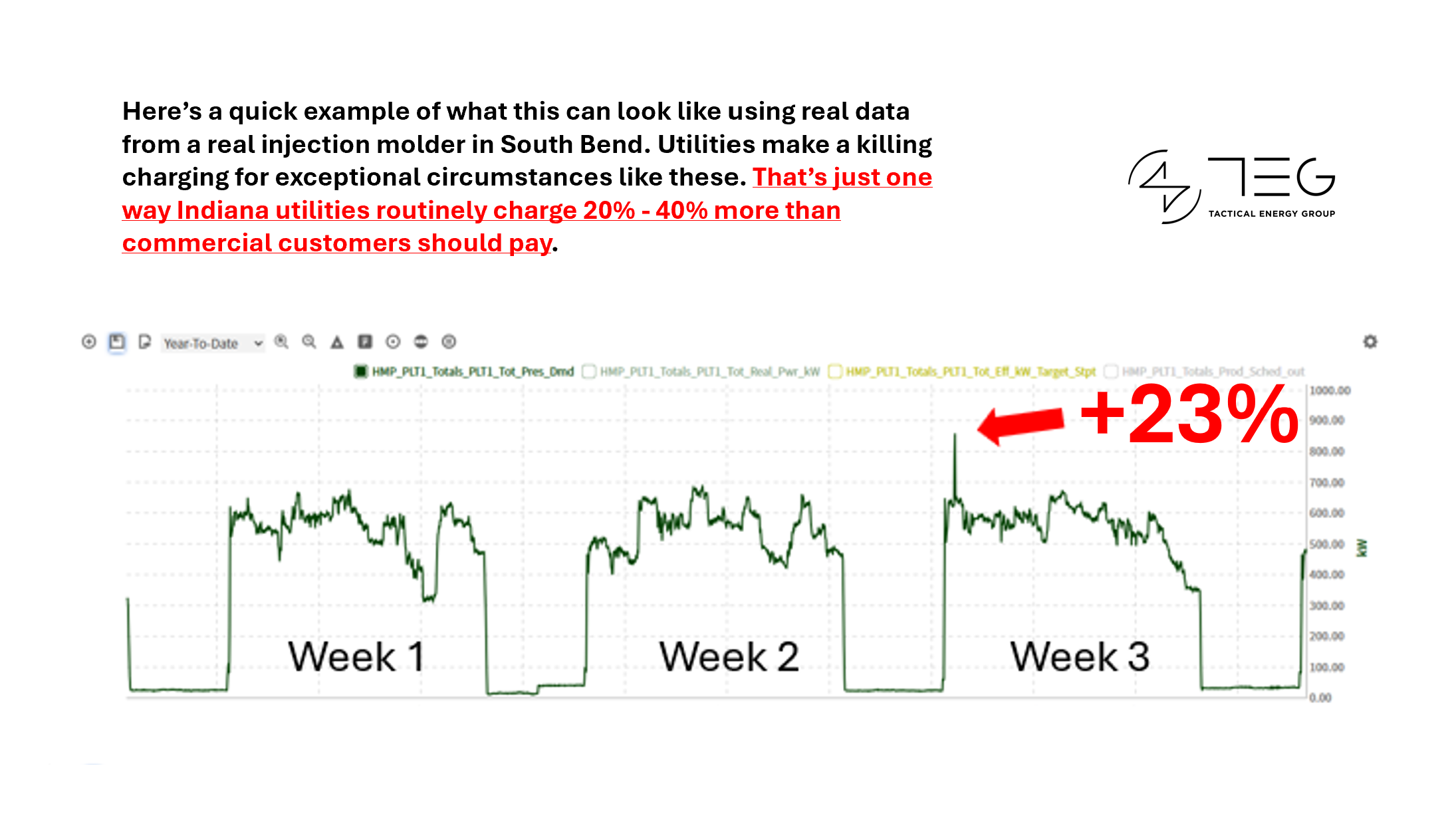
If you run a plant, a hospital, a school system, a city, or a large commercial facility, and you keep seeing a giant line item on your electric bill labeled "demand" that jumps around for reasons that aren't obvious — this post is for you.
If you've done projects, tried to use less, and still watched your bill refuse to move the way it should — this one is definitely for you.
By the time you finish reading, you'll understand what demand charges actually are and how they work, why one bad 15-minute period can wreck your entire month, what load factor is and why it's the only metric that actually tells you whether a project will improve your costs, and what to ask any vendor who claims they can cut your demand charges before you let them anywhere near your operation.
Your electric bill has three main pieces.
Fixed charges are the cost of being connected to the grid at all. They show up as a customer charge or connection fee, and you pay them whether your facility runs flat-out or sits idle. They don't respond to how much you use or when.
Energy charges are the cost per kilowatt-hour — how many units you actually consumed during the billing period. If you have a 4-kilowatt load running for 8 hours, that's 32 kilowatt-hours. Most operators have some intuitive sense of this piece, even if the numbers are frustrating.
Demand charges are where things go sideways for most operators.
Demand is measured in kilowatts, not kilowatt-hours. The distinction matters. Think of it this way: if you buy an 8-inch pipe but only run a trickle of water through it, you're paying for 8 inches of demand. The pipe is the demand. What actually flows through it is your energy consumption.
On your bill, the utility is charging you for the size of that pipe — specifically, the biggest pipe you needed during any 15- or 30-minute window in that billing period. The meter watches your load continuously in those intervals. The highest average load you hit in any single window becomes your billable demand for the whole month.
The stacking piece is what surprises most operators. If an AC unit pulls 4 kilowatts and a water heater pulls 4 kilowatts at the same time, your stack in that interval is 8 kilowatts. Run them one after the other, and the stack never exceeds 4. Same total energy consumed by the end of the day. Very different billable demand.
From the utility's perspective, they have to build and maintain enough capacity to handle everyone's worst-case peak at the same time. Not a typical Tuesday morning — the worst hour of the hottest day when every chiller, every press, and every air handler is running simultaneously. That means they build generation and transmission infrastructure for the peak, not the average.
Demand charges are how they fund that ready-and-available capacity so the grid doesn't collapse when everyone leans on it at once. In theory, the customers who pull the most volatile and stressful load pay more for that behavior.
In practice, that story has gotten weaker. A lot of utilities have been reducing base load capacity and reserve margin while still collecting rising demand charges that were originally supposed to fund that margin. The equitable cost-recovery argument is thinner today than the textbooks suggest.
But you and I don't get to vote demand charges off your bill. They're there. So the real question is: how do they work on your specific rate, and how do you use that understanding to control your all-in cost per kilowatt-hour?
The most important concept in this entire conversation is load factor.
Load factor is the ratio of kilowatt-hours you actually consume in the month compared to the potential kilowatt-hours implied by your peak demand. It's the relationship between the size of the pipe you're being billed for and how much you actually push through it.
The clearest way to see it is the 12-passenger van analogy Daniel uses. If you buy a 12-passenger van and only ever haul three riders, you're spreading the cost of that van over three daily passengers. Huge capacity, low utilization — a poor use of funds. That's what a bad load factor looks like.
To improve load factor and drive your all-in cost down, you want to do the opposite: use the smallest van you can reasonably get away with, and fill it as close to capacity as possible every time you run it.
In billing terms, the van is your peak demand in kilowatts. The riders are the kilowatt-hours you actually consume inside that capacity. If you drag your demand up without a proportional increase in kilowatt-hours, your cost per unit climbs. If you hold demand down and push a lot of kilowatt-hours through that smaller pipe, your cost per unit falls. That relationship is load factor.
The specific flavor of demand charge on your rate changes the game.
Some facilities are on a simple max demand structure: the utility looks at the whole month and asks what's the highest 15- or 30-minute stack you hit. That single period sets your demand charge for the entire billing period.
Others are on time-of-use demand: same concept, but only inside a defined window — say 4 to 9 p.m. The utility is signaling that system-wide stress is concentrated there, and they care a lot more about what you're doing in that window than at 3 in the morning.
You'll also see flat demand charges (one fixed cost per kilowatt), tiered demand charges (that number changes once you cross a threshold), and in some cases daily demand charges where each day carries its own mini demand charge based on that day's peak.
Historically, these structures have been aimed at commercial and industrial users. But they're starting to show up in residential rates too — especially combined with storage options.
Then there are demand ratchets, which deserve their own attention.
A ratchet is a reservation clause. It says: no matter what you actually do this month, you'll never be billed on less than a specified amount of demand. One common structure sets a minimum billing demand and then says that during certain months, your billable demand can never be less than 70 percent of your highest summer peak.
So if you hit a 400-kilowatt peak in August, and November is quiet and your meter only ever sees 150 kilowatts — you're not billed on 150. You're billed on 280, which is 70 percent of that August peak you set months earlier.
The practical implication: you cannot casually set some extreme summer peak and then forget about it. You'll be paying for that decision in quieter months long after the event has passed.
Some tariffs have fixed minimums. Some have variable minimums tied to prior periods. The more complex the design, the less chance a normal operator has of reading the tariff and using it strategically. The engineers and consultants who design these rates are almost completely divorced from the reality of running a plant or facility. On paper, the rate design is supposed to guide customer behavior. In practice, it's so convoluted that most commercial and industrial customers don't know how to read the bill, let alone turn the rate book into an operational playbook.
For many large users, demand charges represent between 30 and 70 percent of the total bill. That's not a rounding error — it's the majority of what you're paying.
A single bad 15-minute window can set your peak for the entire month. A cluster of large motors starting simultaneously. An HVAC control going haywire. A control system failure. You pay demand charges on that peak whether it was a planned operating condition or a freak incident.
That's why your bill can jump significantly even when your total kilowatt-hours barely move. And that's where the common misconception lives: "We used less this month — why is the bill still so high?" If you're not looking at demand and kilowatt-hours together through the lens of load factor, you never get a satisfying answer to that question.
Demand-related plays are a winner when:
One note on backup generation: when you can use prime-rated backup generation to keep operations running, shave peaks, and participate in demand response events, you turn a stranded backup asset into something with multiple payback channels. That combination is often a better play than simply agreeing to curtail.
Demand-related plays are a terrible idea when:
The vendor landscape around demand is rough. Unless a vendor can speak directly to your specific utility rate and show you — accurately — what your all-in cost per kilowatt-hour will be after their project performs as projected, they're guessing. And you're funding those guesses.
Four things to demand before you commit to anything:
1. What impact will this project have on our load factor? If they can't explain load factor and show how their project moves it, the conversation is over. Load factor is not a secondary metric. It's the central one for commercial and industrial cost management.
2. Show me our before and after all-in cost per kilowatt-hour using our actual utility data on our exact tariff. Not total bill dollars. All-in cost per kilowatt-hour: demand plus energy on the bill, divided by total kilowatt-hours consumed. If they can't give you that number with precision, there's no basis for evaluation.
3. Run those numbers using a functional model of our utility's rate calculator — including riders and ratchets. Not a generic spreadsheet. A model that reflects how your utility's billing system actually calculates your bill today. If they can't do this, any savings projection is decoration.
4. Show me case studies from companies that look like ours. Same industry, similar shift patterns, on the same rate or a close equivalent. Not a project in a different context from several years ago. If they can't provide that, the glossy deck doesn't matter.
Demand charges are a winner when you can improve load factor — holding demand down while running as many useful kilowatt-hours as possible through the capacity you're being billed for. High-utilization operations with real monitoring and the ability to make relatively low-disruption operational adjustments get the most out of the current billing structure.
Demand-related work is a terrible idea when a vendor can't explain load factor, can't model your specific rate, and can't show you what your future all-in cost per kilowatt-hour will actually look like.
The single most important concept to carry forward: you don't manage demand and kilowatt-hours as separate line items. You manage the relationship between them. That relationship is called load factor, and it's the lens through which every demand-related decision should be evaluated.
Every utility rate is a set of plays you can run. Run them poorly and you can earn yourself a high all-in cost per kilowatt-hour even on a favorable rate. Run them well and you can earn a low all-in cost on a mediocre one.
Your edge isn't memorizing tariff tables. It's asking the right questions and refusing to approve projects you can't see clearly in the numbers on your bill.
Part 2 on demand charges goes deeper into specific plays operators are running — with monitoring, storage, and generation — to move their all-in cost per kilowatt-hour in the right direction. If you want to understand how demand charges fit into the broader picture of what you pay for electricity, the posts on load factor and utility rate structures cover the foundation.
Visit tac-nrg.com for practical tools built for facilities in Indiana.